Back to Real Estate Definitions
Fact-checked by a REMAX Thailand Real Estate Expert
Legal Document, Lease Form
What is Tor.Dor.11 in Thailand?
The Definition
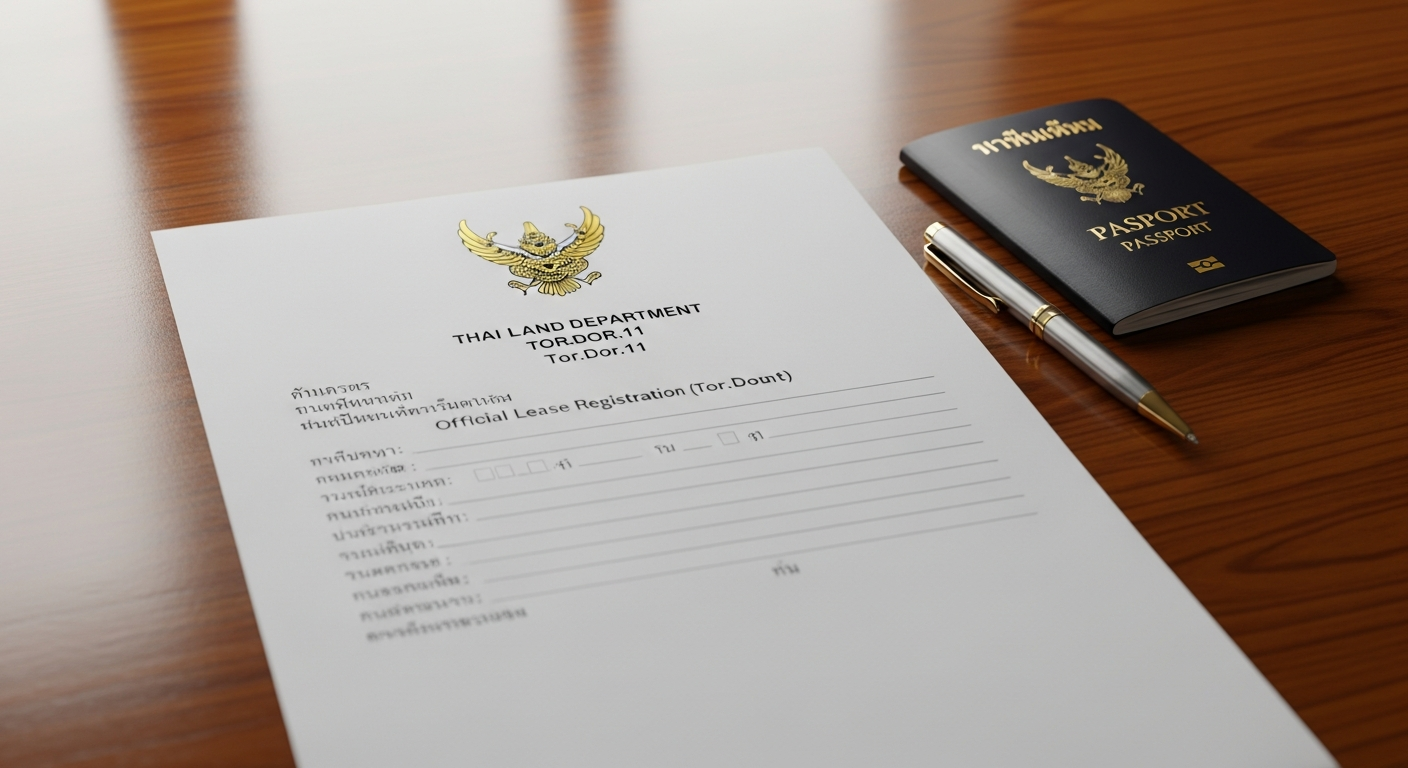
Tor.Dor.11 (ท.ด.11) is the official standardized Land Department form for registering land leases in Thailand, featuring the Garuda emblem and used exclusively at the Land Office to create enforceable lease rights against third parties like subsequent buyers or creditors. It records only essential lease terms such as parties, property description, duration (up to 30 years), and rent, making it the sole registered instrument for legal protection. A detailed private lease can supplement it but must be referenced and attached to Tor.Dor.11 for full effect.
Global Expectations vs. Thai Reality
Western buyers often expect a single comprehensive lease agreement with detailed clauses on renewals, disputes, and warranties to fully protect their rights, similar to registered deeds in common law countries. In Thailand, however, the private lease provides these details but holds no standalone legal weight against third parties unless registered via the concise Tor.Dor.11 form at the Land Office. This dual-system approach surprises foreigners, as unregistered private leases risk being ignored in disputes with new owners or creditors, prioritizing public record over private contract depth.
The Problem It Presents
Buyers overlooking Tor.Dor.11 registration may sign detailed private leases that fail against third parties, leaving them vulnerable if the land sells or faces creditors. Absent parties without official Tor.Dor.21 POA risk lease rejection at the Land Office, delaying transactions and incurring extra travel costs. Foreigners building on leased land without referencing superficies in Tor.Dor.11 could lose improvements to the landowner without compensation upon lease end.
Foreigner vs. Thai Citizen Rules
Foreigners rely heavily on Tor.Dor.11-registered leases for land access since they cannot own land outright under the Land Code Act, making registration essential for 30-year security on restricted properties. Thai citizens face no such ownership bans and may prefer sales over leases, but both must use Tor.Dor.11 for registered leases; foreigners often pair it with private leases specifying building rights due to improvement reversion risks under the Sap-Ing-Sith Act Section 11 without agreements.
The Thai Legal Context
Tor.Dor.11 is governed by the Land Code Act (administered by the Department of Lands), requiring registration for lease enforceability under Sections related to land rights and third-party protection. It mandates official Power of Attorney (Tor.Dor.21) for absent parties and limits terms to 30 years per registration, with extensions needing new filings. Related rules appear in the Civil and Commercial Code for lease extensions and superficies, but Land Office procedures dictate Tor.Dor.11 exclusivity.
Benefits & Risks
Advantages
- Provides the only enforceable protection against third parties when registered, securing long-term use (up to 30 years) for foreigners on restricted land.
- Standardized and quick to process at Land Offices, minimizing disputes over form validity with its Garuda emblem.
- Enables attachment of detailed private leases, combining official enforceability with custom protections like renewals or arbitration.
Risks & Disadvantages
- Limited to essential terms only, forcing reliance on unenforceable private addendums if not properly attached.
- Strict 30-year cap per registration requires renewals, risking non-extension if landowner refuses.
- Requires physical presence or official POA, complicating deals for overseas buyers and adding notary/translation fees (5,000-20,000 THB).
Showcase: How It Works
Let’s look at a real-world scenario to understand how Tor.Dor.11 is applied during a property transaction.
The Scenario
- A foreign expat leases a 1-rai plot in Hua Hin (Chanote title, appraised at 5 million THB) from a Thai owner.
- Agrees to 20,000 THB annual rent over 30 years with a bilingual private lease detailing renewal options and building ownership.
- Registers Tor.Dor.11 at Land Office with Tor.Dor.21 POA, referencing the private lease (Cost: ~232,000 THB fees/tax).
The Result
Original title deed, IDs, and zoning confirmation (residential allowed) are presented; the lease registers in 1-2 hours.
Outcome:
Lease rights now bind the title deed publicly; expat secures 30-year use and building ownership, protected for ~232,000 THB total setup.
Tor.Dor.11 vs. Private Lease (Unregistered)
A quick breakdown of how this term compares to its closest alternative.
| Feature | Tor.Dor.11 | Private Lease (Unregistered) |
|---|---|---|
| Enforceability | Binds third parties via Land Office record | Does not bind third parties unless attached |
| Detail Level | Essentials only (parties, duration, rent) | Detailed warranties & renewals |
| Foreigner Utility | Essential for land access/security | Enhances but alone risks total loss |
Frequently Asked Questions
Can Tor.Dor.11 be renewed beyond 30 years?
Yes, but requires a new registration at the Land Office; include renewal rights in the attached private lease to negotiate extensions smoothly.
What if I'm abroad—can I still register?
Use official Tor.Dor.21 POA notarized at a Thai embassy; private POAs won't work—plan 7-10 days for prep.
Does it protect my house built on leased land?
Not inherently; reference superficies rights in the attached private lease to claim building ownership separately under Civil Code Sections 1410-1416.
How much does registration cost?
Expect 1-2% tax on annual lease value (e.g., 2,000 THB/year rent = 40 THB tax) plus 1,000-5,000 THB fees; total under 20,000 THB for most deals.
Is Tor.Dor.11 needed for condo leases?
No, primarily for land; condos use separate agreements, but land plots under villas always require it for enforceability.
Related Terms
Why It Matters
Ignoring Tor.Dor.11 leaves leases vulnerable to property flips or debts, potentially costing foreigners millions in lost investments on non-owned land. Mastering it ensures your 30-year stake is ironclad on Thailand titles, avoiding reversion traps.
💡 REMAX Pro Tip
Always pair Tor.Dor.11 with a notarized bilingual private lease explicitly referenced ("see attached exhibit") and use our official Tor.Dor.21 POA service to register remotely—saves 50% hassle vs. flying in.
Common Misconceptions
Myth: A detailed bilingual private lease alone is sufficient for legal protection in Thailand.
Reality: Private leases are not registered and hold no weight against third parties unless referenced and attached to the official Tor.Dor.11 form.
Myth: Foreigners can secure indefinite land rights just by signing Tor.Dor.11.
Reality: Maximum 30 years per term; renewals need new registration, and buildings may revert without superficies or agreements.
Need more help?
Our expert agents and AI are ready to assist you.
Ask Line AI Ask WhatsApp AI Find an Agent