Back to Real Estate Definitions
Fact-checked by a REMAX Thailand Real Estate Expert
Legal Document
What is Certificate of Use in Thailand?
The Definition
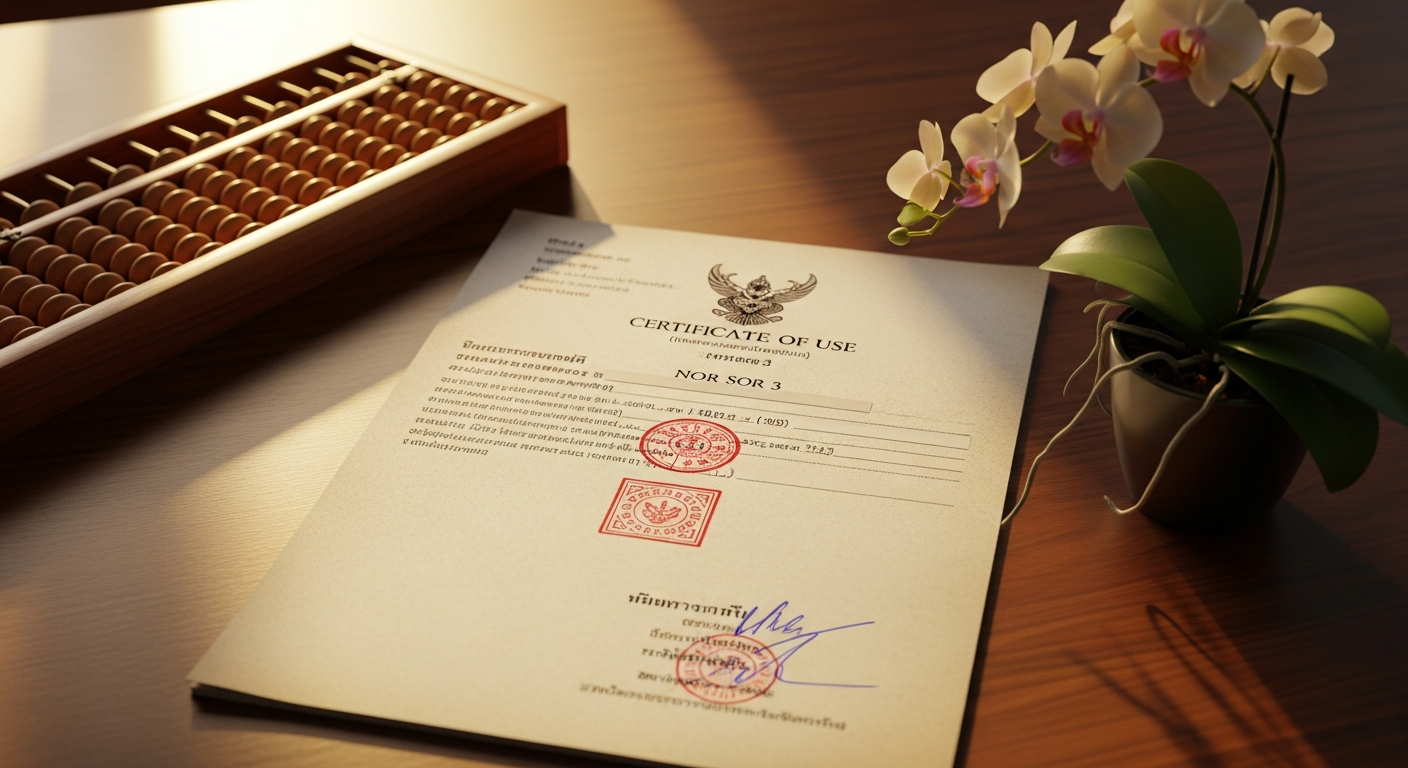
The Certificate of Use (Nor Sor 3, Nor Sor 3 Gor, or Nor Sor 3 Kor) is a document issued by the Department of Lands certifying that land has been put to productive use by the possessor, granting possessory rights but not full ownership. It serves as an interim title, often issued after a land survey or verification under the Land Code, and can be upgraded to a full Title Deed (Chanote/Nor Sor 4) once conditions are met. Holders can sell, lease, or mortgage the land, subject to registration and restrictions.
Global Expectations vs. Thai Reality
Western buyers might expect a Certificate of Use to equate to a full ownership title deed with unrestricted rights, similar to a U.S. warranty deed or European freehold certificate, but in Thailand, it only confirms possession and use, not absolute ownership, requiring further surveys for upgrade. Transactions demand Land Department registration and often a 30-day publication period for objections, unlike immediate transfers in many Western systems. It carries ongoing obligations like productive use, with revocation risks for abandonment, contrasting with perpetual ownership expectations abroad.
The Problem It Presents
Buyers unaware of its interim status may overpay for land assuming full ownership, only to face upgrade delays or denials due to incomplete surveys. Transactions require dual registration (first in Certificate of Use, then supporting documents) and 30-day objections, causing delays and legal challenges if contested. Abandonment over 12 years (for some types) or non-productive use risks revocation, leaving holders without recourse.
Foreigner vs. Thai Citizen Rules
Foreigners cannot directly own land in Thailand under the Land Code Act Section 86 (except rare treaty cases), so they rarely hold Certificates of Use personally and instead use structures like condominiums or leases; Thai citizens can possess and upgrade these to full ownership. No explicit differentiation in issuance rules, but foreigners face stricter enforcement on use restrictions and cannot inherit or transfer land rights directly.
The Thai Legal Context
Governed by the Land Code Act (B.E. 2497), particularly Sections 57, 58, 58 bis, and 59, which outline issuance after cadastral surveys or use verification by provincial land officers. The Department of Lands (under the Ministry of Interior) issues and registers it, with details like land location, area, and boundaries signed and sealed. Supporting laws include the Act on Land Allocation for Living B.E. 2511 for specific types like Nor Kor 3.
Benefits & Risks
Advantages
- Provides transferable possessory rights, allowing sale, lease, or mortgage sooner than non-transferable certificates.
- Pathway to full Chanote title deed via Land Department survey, securing long-term ownership.
- Confirmed versions (Nor Sor 3 Kor/Gor) offer near-equivalent security to Chanote for transactions.
Risks & Disadvantages
- Not proof of ownership; vulnerable to government revocation for non-use or violations.
- Transfer restrictions (e.g., 10-year ban post-conversion in some cases) limit liquidity.
- Requires ongoing supervision and productive development, with potential 30-day sale delays.
Showcase: How It Works
Let’s look at a real-world scenario to understand how Certificate of Use is applied during a property transaction.
The Scenario
- A Thai farmer holds a Sor Kor 1 on 5 rai of agricultural land in Chiang Mai (appraised at 2.5M THB).
- After 2 years of planting rice, Land Department verifies productive use under Land Code Section 58 and issues Nor Sor 3.
- Farmer sells to buyer for 3,000,000 THB; they register the transfer and buyer applies for Chanote upgrade.
The Result
Buyer gains possessory rights immediately, nets full ownership after upgrade survey, paying approximately 210,000 THB in total government fees.
Outcome:
210,000 THB Fees & Full Ownership
Certificate of Use vs. Chanote (Title Deed)
A quick breakdown of how this term compares to its closest alternative.
| Feature | Certificate of Use | Chanote (Title Deed) |
|---|---|---|
| Ownership Rights | Possessory Only | Full Ownership |
| Transaction Speed | 30-Day Delay (Publication) | Immediate Transfer |
| Boundaries | Survey Required | GPS Defined |
Frequently Asked Questions
Can I build a house on Nor Sor 3 land?
Yes, with Land Department approval for possession-confirmed titles, but construction permits require verified use to avoid demolition risks.
How long until Nor Sor 3 upgrades to Chanote?
Typically 6-24 months post-survey application, depending on backlog; confirmed types (3 Gor/Kor) qualify faster.
Is Certificate of Use insurable for foreigners?
No direct ownership, so title insurance is limited; use leasehold structures instead for expat protection.
What if the land is left unused?
Revocation after 12 years (3 Kor) or non-compliance; holder loses all rights without compensation.
Does it transfer on inheritance?
Yes, fully transferable by inheritance, but sales need Land Office registration first.
Related Terms
Why It Matters
Ignoring Certificate of Use status risks buying non-upgradeable land, leading to investment loss or endless disputes; it’s a critical step to full ownership under Thai law. Sellers must disclose it to avoid liability in transfers.
💡 REMAX Pro Tip
Always demand a Land Office "title search" extract showing Nor Sor 3 subtype (e.g., Kor for confirmed) and recent use verification—avoid deals without it, as upgrades can take 6-12 months.
Common Misconceptions
Myth: Certificate of Use grants full ownership like a Chanote.
Reality: It certifies only possession and use, not ownership; full rights require upgrading to a Title Deed.
Myth: Foreigners can easily buy and hold land under this certificate.
Reality: Foreigners are barred from direct land possession; they must use Thai nominees or condos, risking legal issues.
Need more help?
Our expert agents and AI are ready to assist you.
Ask Line AI Ask WhatsApp AI Find an Agent