Back to Real Estate Definitions
Foreign Ownership Structure
What is US-Thai Treaty of Amity in Thailand?
Fact-checked by a REMAX Thailand Real Estate Expert
The Definition
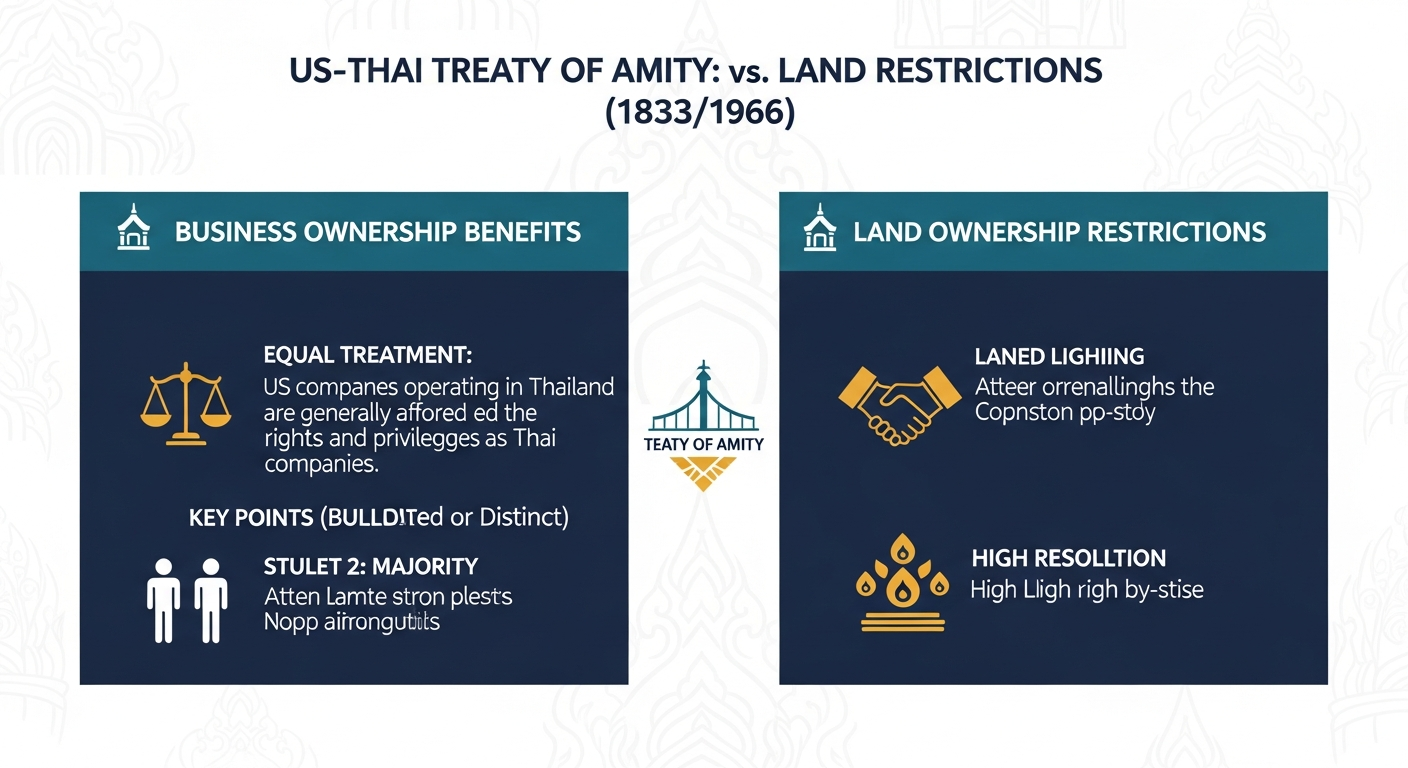
The US-Thai Treaty of Amity is a bilateral treaty that gives qualifying U.S. citizens and U.S.-majority-owned companies special business rights in Thailand, but it is not a direct property ownership law. In Thai real estate, its practical relevance is mainly through company ownership structures that may be used to hold assets or conduct business, rather than giving an American individual the right to freely own land in Thailand.
The Thai Legal Context
In Thailand, real estate ownership is governed primarily by the Land Code Act, the Civil and Commercial Code, and the Condominium Act. Foreigners are generally prohibited from owning land directly in their own name. The US-Thai Treaty of Amity does not work like a simple exemption allowing a U.S. person to buy Thai land personally. Its common property-market use is indirect: U.S.-linked businesses may qualify for special corporate treatment under the treaty, but that does not override Thai land ownership restrictions. Any land-holding structure must still comply with Thai land and company rules. Buyers often assume a treaty or company setup means "ownership," but the real issue is whether the structure is legally robust and registrable at the Department of Lands. Careful structuring is required to avoid unexpected costs, legal compliance issues, and tax consequences.
Benefits & Risks
Advantages
- Can support a U.S.-qualified business structure useful for operating in Thailand.
- May provide a commercial pathway for certain asset-holding or investment strategies.
Risks & Disadvantages
- Does not give a U.S. individual freehold land ownership rights in Thailand.
- Misusing a company structure can create regulatory, tax, and nominee-risk issues.
Showcase: How It Works
Let’s look at a real-world scenario to understand how US-Thai Treaty of Amity is applied during a property transaction.
The Scenario
- A U.S. investor wants an 18MB Phuket villa on 800 sq.m of land and believes the treaty allows direct land purchase.
- Their lawyer clarifies the treaty does not bypass the Thai Land Code.
- The investor instead opts for a 30-year registered lease for the land and buys the villa structure separately.
The Result
The transaction takes 45–60 days. The investor pays legal fees (THB 150K), lease registration (THB 80K), and due diligence (THB 25K), ensuring legal compliance.
Outcome:Total upfront costs of THB 255,000 for legally recognized long-term control via a registered lease.
Frequently Asked Questions
Does the US-Thai Treaty of Amity let an American buy land in Thailand?
No. Thai land ownership restrictions still apply, and the treaty does not give a U.S. individual blanket land ownership rights.
What is the treaty actually useful for in real estate?
It is mainly relevant for company structure and business rights, which may indirectly affect how assets are held or developed, but it is not a substitute for Thai property law.
Can a U.S. company own Thai land under the treaty?
Not automatically. Any company-based land-holding structure must still comply with Thai land rules, company ownership rules, and Land Office registration requirements.
Related Terms
Why It Matters
The US-Thai Treaty of Amity is important because many buyers misunderstand it as a shortcut to land ownership. In reality, Thai property law controls what foreigners can own. Incorrectly structuring a deal can lead to lost money, delayed transfers, or unprotected investments.
💡 REMAX Pro Tip
Always ask your Thai lawyer to confirm the exact ownership path at the Land Office before you sign; never rely on marketing claims that "the treaty allows ownership" without a title-level legal review.
Need more help?
Our expert agents and AI are ready to assist you.
Ask Line AI Ask WhatsApp AIFind an Agent