⏱️ Estimated Reading Time: 4 mins
Back to Real Estate DefinitionsLegal Document
What is Deed in Thailand?
Fact-checked by a REMAX Thailand Real Estate Expert
The Definition
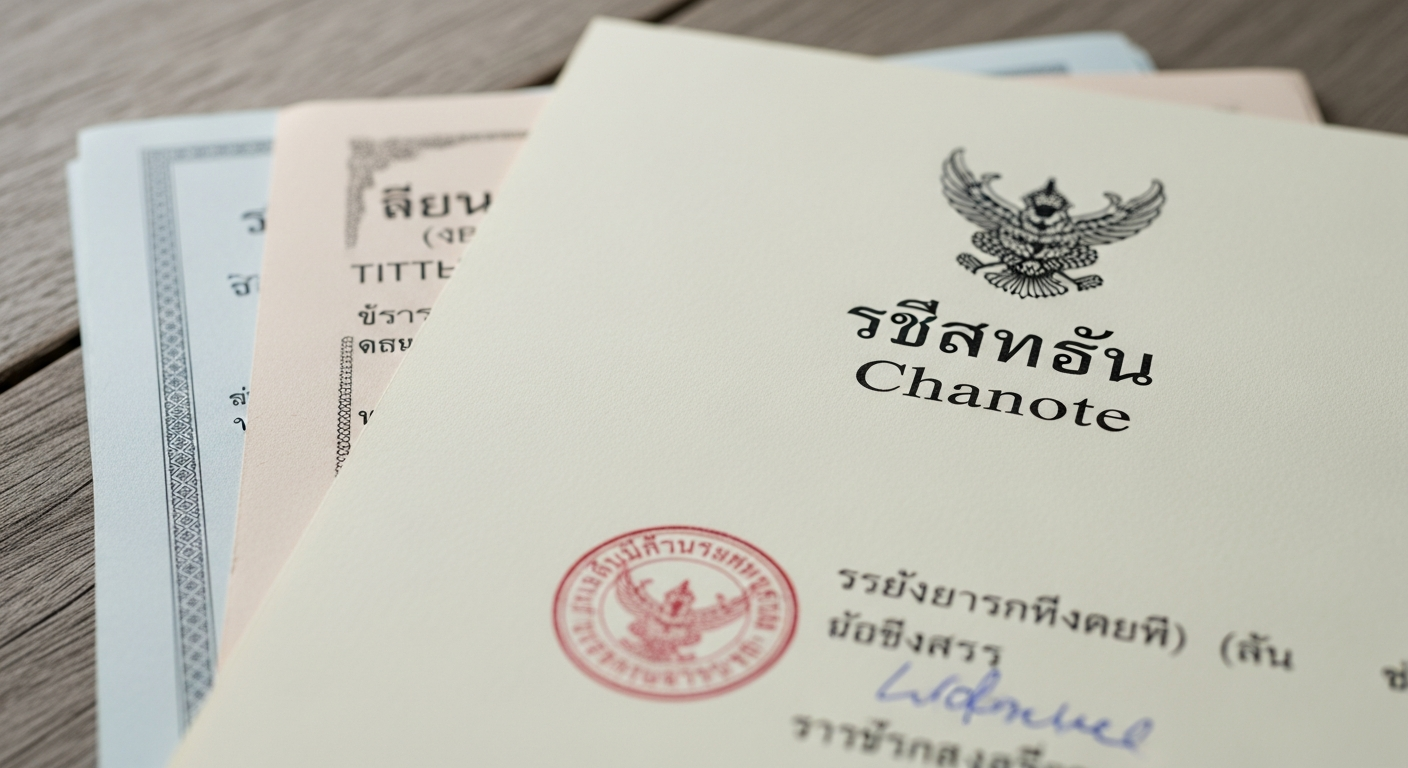
In Thailand, a **deed** refers to the official land title deed (known as "Chanote" or "Nor Sor 4 Jor" for the highest form), issued by the local Land Department, which serves as conclusive proof of land ownership, detailing boundaries, size, owner information, and any encumbrances like mortgages. It grants full rights to sell, lease, mortgage, or develop the land as per zoning.
Global Expectations vs. Thai Reality
Western buyers often expect a single, standardized "deed" like a warranty deed with automatic title insurance and minimal government verification. However, in Thailand, deeds vary significantly by type (e.g., Chanote vs. Nor Sor 3). Transactions require manual Land Office checks for authenticity, encumbrances, and road access rights, as no standard title insurance exists.
The Problem It Presents
Buyers risk fraud from fake or outdated deeds, as verifying authenticity requires in-person Land Office checks. Disputes often arise over boundaries or hidden mortgages not visible online. Lesser deeds like Nor Sor 3 limit development or sales, potentially trapping sellers in illiquid properties with high holding costs.
Foreigner vs. Thai Citizen Rules
Thai citizens can directly hold full ownership via Chanote deeds with unrestricted rights. Foreigners are generally prohibited from owning land outright under the Land Code and cannot be named on land deeds. Instead, they typically invest in condos (up to 49% foreign quota), long-term leases, or highly restricted permissions.
The Thai Legal Context
Title deeds are governed by the Land Code B.E. 2497 (1954) and administered by the Department of Lands (Sor Nor), which issues and registers them. The Revenue Department handles associated taxes during transfers (e.g., transfer fees, withholding tax), while AMLO screens high-value transactions for compliance. Local Land Offices must verify deeds during every sale to ensure no liens exist.
Benefits & Risks
Advantages
- Provides ironclad proof of ownership, enabling full use, sale, or mortgage with government backing.
- Precise GPS-surveyed boundaries (Chanote) reduce boundary disputes, making it ideal for development.
- High resale value, especially for Chanote titles, boosting investment returns.
Risks & Disadvantages
- Restricted for foreigners, often forcing complex or indirect holding structures prone to legal challenges.
- Transfer process demands significant fees (approx. 2% transfer fee + taxes) and physical presence at the Land Office.
- Vulnerable to forgery without professional verification; due diligence is mandatory.
Showcase: How It Works
Let’s look at a real-world scenario to understand how Deed is applied during a property transaction.
The Scenario
- A Thai buyer purchases a 1 Rai Chanote-titled plot in Chiang Mai for 5,000,000 THB.
- Both parties present the original Chanote at the Land Office for verification of clean title.
- Fees are paid: 2% transfer fee, 0.5% stamp duty, and 1% withholding tax.
The Result
The Land Officer cancels the seller's name, registers the buyer, and issues a new duplicate Chanote (one for the buyer, one filed). The process typically takes 1-2 hours.
Outcome:~97,500 THB (Buyer's Share)
Deed vs. Nor Sor 3
A quick breakdown of how this term compares to its closest alternative.
| Feature | Deed | Nor Sor 3 |
|---|---|---|
| Ownership Rights | Full ownership; sale/lease allowed | Possession rights; 30-day notice required |
| Boundaries | GPS-precise concrete posts | Approximate maps; risk of disputes |
| Development | Immediate development permitted | Often restricts building without upgrade |
Frequently Asked Questions
What is the difference between Chanote and other deeds?
Chanote (Nor Sor 4 Jor) grants full ownership with precise GPS boundaries. Other deeds like Nor Sor 3 only grant possession rights, have less accurate boundaries, and face more restrictions on transfers.
Can foreigners get a deed for land?
No, land deeds in Thailand can only name Thai citizens or companies. Foreigners usually hold deeds for condos (up to 49% of the building) or register long-term leases on the land deed.
How do I verify a deed?
You must visit the local Land Office for a title search. This checks the current owner, verifies the document's authenticity, and reveals any encumbrances like mortgages or liens.
What fees apply when transferring a deed?
Standard fees include a 2% transfer fee, 0.5% stamp duty (or 3.3% Specific Business Tax if held short-term), and 1% withholding tax based on the appraised value.
Can a deed be upgraded?
Yes, a Nor Sor 3 deed can often be upgraded to a Chanote title by applying for a formal survey at the Land Office, provided the land is not in a restricted zone.
Related Terms
Why It Matters
A flawed or fake deed can invalidate your ownership, leading to total financial loss via disputes or forced sales. Always verify the deed to secure your multi-million THB investment.
💡 REMAX Pro Tip
Insist on seeing the **original Chanote** at the Land Office before paying any deposit—never rely on copies. Hire a lawyer or agent to perform a title search (approx. 20,000 THB) to spot hidden liens early.
Common Misconceptions
Myth: All deeds grant full ownership like in the West.
Reality: Only Chanote (Nor Sor 4 Jor) provides full ownership. Others like Nor Sor 3 or SPK have severe restrictions on transfer or building.
Myth: Foreigners can buy land if named on the deed.
Reality: Foreigners cannot be listed as land owners on any deed; violations lead to forced sales or penalties.
Need more help?
Our expert agents and AI are ready to assist you.
Ask Line AI Ask WhatsApp AIFind an AgentWritten and Verified by
REMAX Thailand Editorial Team
Experts in Thai Real Estate Law & Market Trends