Back to Real Estate Definitions
Building Law / Permit Law
What is Building Control Act B.E. 2522 in Thailand?
Fact-checked by a REMAX Thailand Real Estate Expert
The Definition
The Building Control Act B.E. 2522 (1979) is Thailand’s primary law for regulating the construction, alteration, use, and safety of buildings. In practice, it is the law that governs whether a building can be lawfully built, modified, or occupied, and it gives local authorities power to approve permits, inspect works, and order corrections or demolition when a building is non-compliant.
The Thai Legal Context
The Building Control Act B.E. 2522 works alongside Thailand’s local building regulations, ministerial rules, municipal bylaws, zoning rules, and land-use controls. Enforcement is typically handled by local administrative authorities and municipal offices, while broader property due diligence often also intersects with the Department of Lands for title verification and with planning/zoning rules that determine what can legally be constructed on a particular plot. In real transactions, a buyer is not just checking ownership; they are also checking whether the building itself was legally approved, built within the permitted envelope, and is eligible for lawful use or later renovation.
Compared with many Western markets, Thailand is often more permit-sensitive and documentation-driven at the local level, especially outside major prime condo projects. A foreign buyer may expect that buying a house or villa means the structure is automatically valid if the land title is clear, but in Thailand the building can still be problematic if the construction permit, setback rules, height limits, or approved drawings do not match what was actually built. This matters even more for foreigners because Thailand’s land-ownership restrictions mean many foreign buyers use leases, company structures, or other rights rather than direct land ownership; however, the building-control rules themselves generally apply based on the property and structure, not the nationality of the buyer, so Thai citizens and foreigners face the same compliance requirements for construction legality.
The most common friction points are hidden non-compliance and unexpected remediation costs. These can include extensions added without permit, roof enclosures that exceed approved plans, unsafe staircases, unlicensed common-area works in a condominium, or a developer advertising a completed home before final approvals are in place. If a buyer discovers a violation late, the cost may involve redesign, retroactive permit work, fines, delays in transfer, or in serious cases an order to modify or remove the offending structure; this is why Thai due diligence should include both title checks and building-permit review, not just ownership review.
Benefits & Risks
Advantages
- Helps ensure a building is lawfully constructed and eligible for occupation, which protects resale value and financing prospects.
- Creates a clear process for permits, inspections, and compliance, reducing unsafe or substandard construction.
Risks & Disadvantages
- A property may have title clarity but still have building-law problems, such as unapproved extensions or non-compliant alterations.
- Fixing violations can create unexpected costs, delays, and renegotiation pressure before transfer or financing.
Showcase: How It Works
Let’s look at a real-world scenario to understand how Building Control Act B.E. 2522 is applied during a property transaction.
The Scenario
- A Thai-registered company plans to buy a detached villa in Phuket for THB 18,500,000.
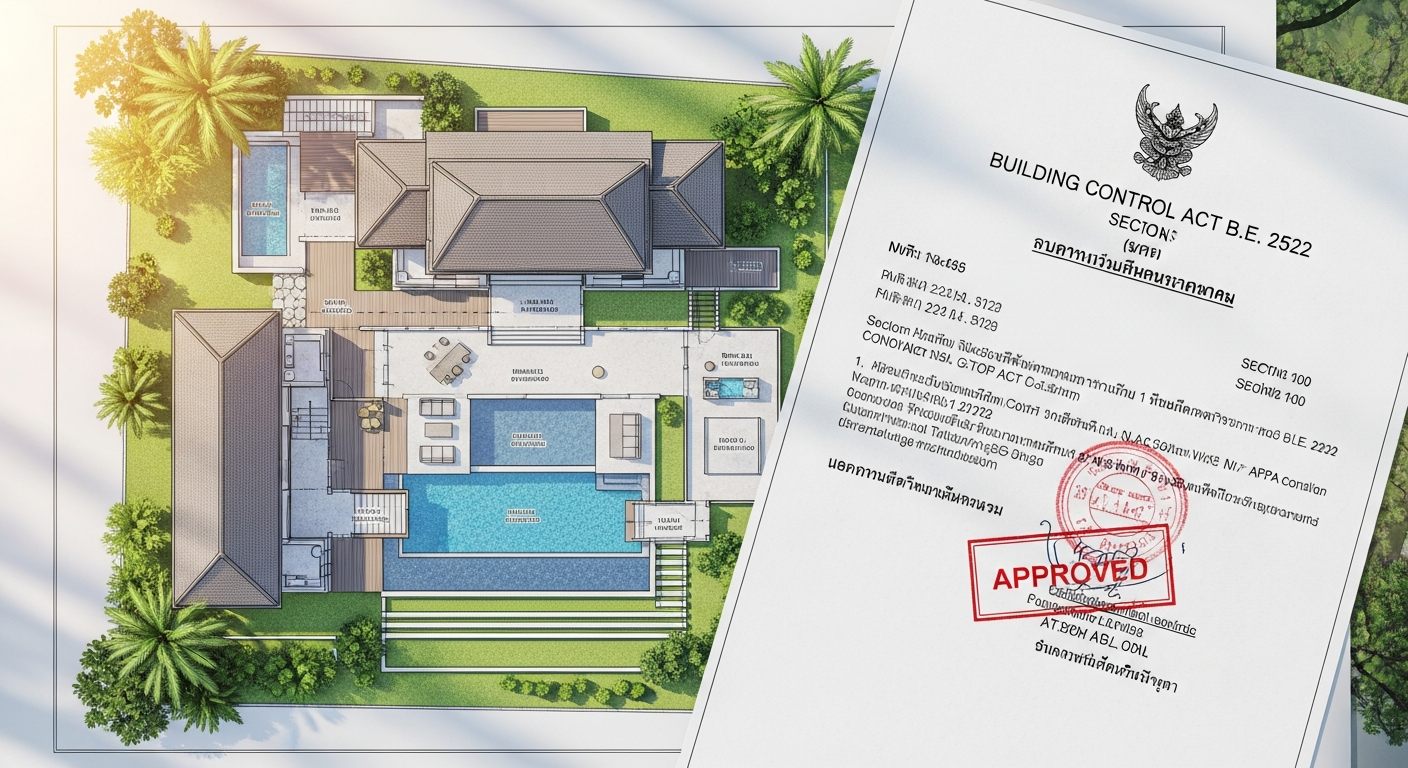
- The buyer’s lawyer finds the enclosed terrace and rooftop pergola were added after the original permit.
- The local municipality says the seller must apply for an amended permit (THB 180,000) or remove non-compliant works (THB 260,000).
The Result
Because the buyer wants to transfer within 30 days, the parties negotiate a price holdback of THB 300,000 in escrow until compliance is proven.
Outcome:Purchase price THB 18,500,000 - holdback THB 300,000 = THB 18,200,000 net paid on transfer.
Frequently Asked Questions
Does the Building Control Act apply to both houses and condominiums in Thailand?
Yes. It applies to building construction and alterations generally, including houses, villas, and condo-related structures and common areas, though the exact permit process differs by project type and location.
Can a foreigner ignore building-permit issues if they only lease the land?
No. Even if the land is leased rather than owned, the building must still comply with Thai building-control rules, and violations can affect use, value, and transferability.
What is the biggest red flag under the Building Control Act for a buyer?
The biggest red flag is a mismatch between the approved plans and the actual construction, such as added rooms, enclosed balconies, or roof structures that were never formally permitted.
Related Terms
Why It Matters
The Building Control Act is what separates a legal building from a property that only looks complete. If you ignore it, you can buy a home that becomes expensive to fix, hard to resell, or difficult to finance later.
💡 REMAX Pro Tip
Before paying a deposit, ask for the approved architectural drawings, building permit, and completion/inspection evidence—and compare them line by line with the actual structure on site. If the roofline, terrace, or room count does not match the permit file, treat that as a negotiating issue, not a cosmetic one.
Need more help?
Our expert agents and AI are ready to assist you.
Ask Line AI Ask WhatsApp AIFind an Agent