← Back to Visa Information 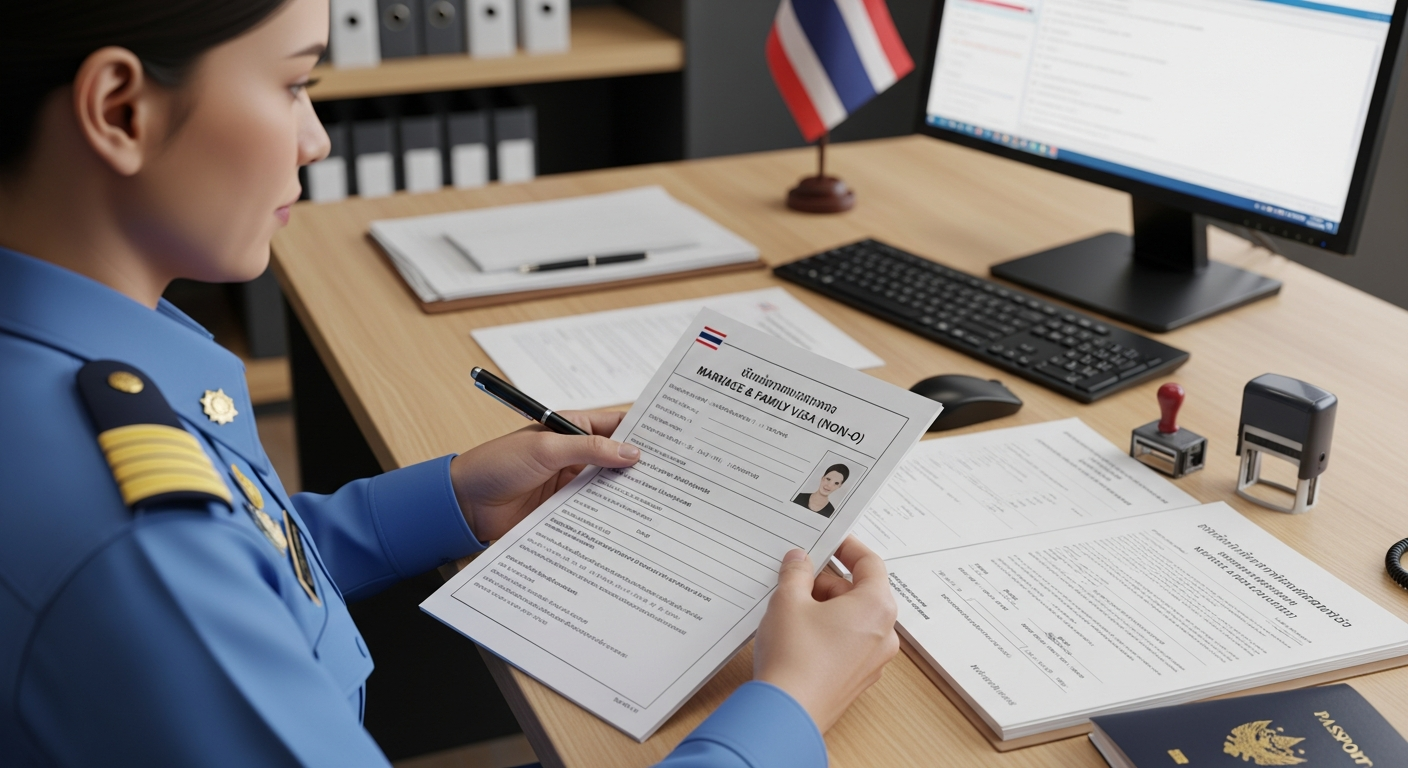
Family & Settlement
Marriage & Family Visa (Non-O)
Relocating to Thailand to build a life with your loved ones is a dream for many. The Non-Immigrant O Visa (specifically the Marriage and Family extensions) is designed for foreigners who are legally married to a Thai national, or those who are dependents of a foreigner legally working or residing in the Kingdom.
Unlike retirement or tourist visas, the Marriage Visa offers incredible versatility. It allows you to build a family home, significantly lowers the financial requirements for staying long-term, and crucially, provides a direct legal pathway to obtaining a Thai Work Permit so you can support your family.
📱 Mandatory TDAC Requirement for Entry
When traveling back to Thailand to join your family, you must complete the Thailand Digital Arrival Card (TDAC) online. Submit your arrival details via tdac.immigration.go.th within 3 days prior to touching down.
Eligibility & Financial Requirements
The primary route for this visa is being legally married to a Thai citizen. To prevent fraudulent \"sham\" marriages purely for visa purposes, Thai Immigration requires robust proof of the relationship alongside specific financial stability metrics.
💵 The Bank Deposit Route
You must show a balance of at least 400,000 THB in a Thai bank account. This money must be deposited and maintained in the account for at least 2 months prior to the date of your visa extension application.
💼 The Monthly Income Route
Alternatively, you can prove a sustained monthly income of at least 40,000 THB. This can be from a pension, overseas earnings, or a salary within Thailand (if you are legally working), verified by your embassy or tax documents.
👨👩👧 "Follower" Dependents
If you are not married to a Thai, but your spouse holds a valid Thai Work Permit (Non-B), or you have a child studying in Thailand (Non-ED), you can apply for the Non-O as their dependent. Financial requirements vary slightly for this track.
The Process & Insider Tips
Securing a marriage visa is highly bureaucratic. It is not just about showing a marriage certificate; you must prove your life is intertwined.
1
Initial 90-Day Visa
You must apply for the initial Non-O Visa at a Thai Embassy abroad (or convert from a tourist visa locally if you meet strict criteria). This gives you 90 days to settle in and prepare your finances.
2
The 1-Year Extension (The Heavy Paperwork)
During the last 30 days of your initial visa, you apply for a 1-year extension. You must bring your spouse to immigration. You will need your marriage certificate (Kor Ror 2 and Kor Ror 3), bank letters, and a hand-drawn map to your residence.
3
Photographic Evidence & Home Visits
Crucial Tip: Immigration requires printed photos of you and your spouse together in your home. You must show photos of yourselves at the front door (showing the house number), sitting in the living room, and even in the bedroom. Officers may also visit your home unannounced to interview your neighbors and confirm you cohabitate.
💼 The Working Advantage
Unlike the Retirement Visa or the standard Tourist Visa, holding a Non-O Marriage Visa allows you to legally work in Thailand—provided you secure a Thai Work Permit.
In fact, being married to a Thai national makes you a highly attractive candidate for employers. Under Thai law, standard companies must hire four Thai nationals for every one foreigner they employ. However, if the foreigner is married to a Thai citizen, that ratio is frequently halved (e.g., 2 Thais to 1 foreigner), easing the corporate burden.
Furthermore, the mandatory minimum salary requirements set by the government for foreign workers are often waived or reduced if the applicant holds a Marriage Visa, allowing you to accept a wider range of job opportunities.
Navigating Real Estate as a Married Couple
Marrying a Thai citizen introduces complex nuances to property ownership. Many foreigners mistakenly believe that marriage grants them the right to own land. This is absolutely false.
Buying Land & Houses: Your Thai spouse can purchase a house and land (e.g., a family home in Chiang Mai). However, the Land Department will require the foreign spouse to sign a formal "Letter of Confirmation." This document legally states that all funds used to purchase the property are the Thai spouse's personal property (Sin Suan Tua), and not marital property (Sin Somros). In the event of a divorce, the foreign spouse has no legal claim to the land.
Buying Condominiums: The safest route for shared investment remains the condominium. Foreigners can purchase and own freehold condominiums entirely in their own name. Many couples choose to buy a condo in Bangkok or Pattaya under the foreigner's name for ultimate security, while building a separate family house in the provinces under the Thai spouse's name.
🎭 Marriage Visa Myths
- Myth: It automatically gives me a Work Permit.
Fact: No. It makes getting a work permit easier for your employer, but you still must go through the formal Department of Employment application process. - Myth: We can get a quick divorce and I keep the visa.
Fact: If your visa is explicitly based on marriage, it terminates immediately upon legal divorce. You must secure a new visa to stay.
✅ What to Do & Avoid ❌
- Do: Keep a robust paper trail of your shared life. Bills, utility accounts, and photos together are essential for your yearly extension.
- Do: Ensure the 400,000 THB remains untouched for exactly 2 months before your extension date. Dropping below this amount for even one day will result in a denial.
- Avoid: Never pay a "fixer" to arrange a fake marriage. Immigration actively investigates and prosecutes sham marriages.
💡 Financial ProTip
When using the 400,000 THB bank deposit method, the money must be in a Thai bank account solely in the foreigner's name. A joint bank account with your Thai spouse will often be rejected by immigration officers, as they cannot verify that the foreign applicant solely controls the required funds.
Frequently Asked Questions
1. Can I work in Thailand on a Marriage Visa?
Yes, but not automatically. The Non-O Marriage Visa allows you to legally apply for a Thai Work Permit. You must secure a job first, and your employer will process the Work Permit using your Marriage Visa.
2. What are the financial requirements for the Thai Marriage Visa?
You must prove either a bank balance of at least 400,000 THB in a Thai bank account (held for at least 2 months prior to application) OR a verified monthly income of at least 40,000 THB.
3. Can I buy land in Thailand if I am married to a Thai citizen?
Foreigners cannot own land freehold, even if married to a Thai. Your Thai spouse can buy the land, but you must sign a legal declaration stating the funds used are their personal property (Sin Suan Tua), meaning you have no legal claim to the land.
4. What happens to my visa if we get divorced?
If your visa extension is based on marriage, it becomes invalid immediately upon formal divorce. You must leave Thailand or apply for a different visa type (like a Non-B if you are working) without delay.
5. Do immigration officers really visit your house?
Yes. When applying for your one-year marriage extension, Thai immigration officers often conduct unannounced home visits or require you to submit photos of you and your spouse in and around your home to prove the marriage is genuine.
Disclaimer: The information provided in this guide is intended for general informational and educational purposes only. Visa regulations, financial requirements, and property ownership laws in Thailand are highly dynamic and subject to frequent changes without prior notice. REMAX Thailand is a real estate agency and does not provide formal legal, marital, or immigration advice. For the most accurate, legally binding information, we strongly advise consulting with a qualified Thai family/immigration lawyer or visiting the official website of the Ministry of Foreign Affairs, Kingdom of Thailand.