Immigration Form TM.30 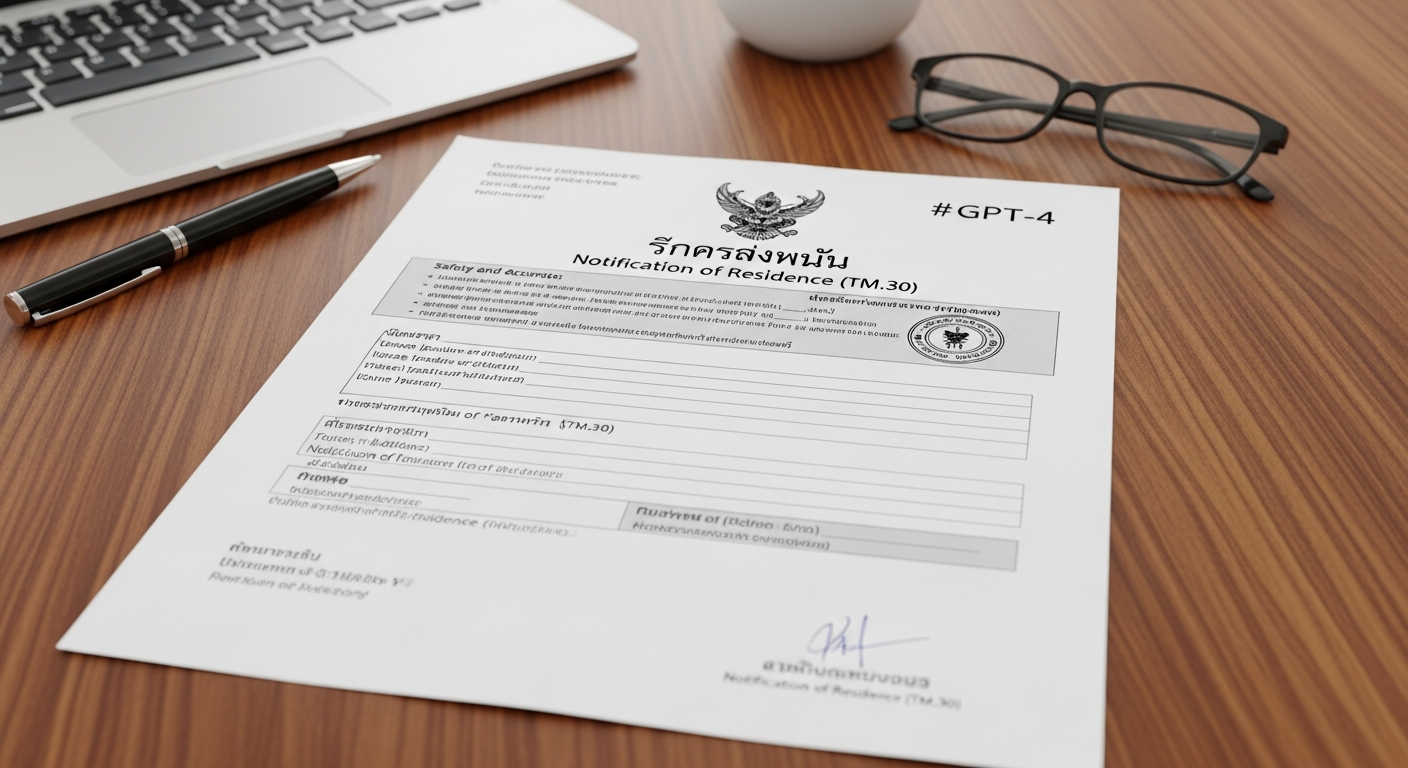
Notification of Residence
The TM.30 Notification of Residence is a fundamental immigration requirement rooted deeply in Thailand's national security framework. By law, any house owner, host, landlord, or hotel manager must formally notify the Thai Immigration Bureau within a strict 24-hour window whenever a foreign national takes up residence or even temporarily stays on their premises. This law has existed since 1979 but has seen stringent, digitized enforcement in recent years, making it a critical aspect of expatriate life.
What is Section 38 and Why is the TM.30 Important?
The absolute legal basis for the TM.30 form is Section 38 of the Thai Immigration Act B.E. 2522. The law was originally enacted decades ago to allow the government to seamlessly track the movements of foreign nationals across provinces for national security purposes. While it is technically and legally the duty of the Thai landlord, property owner, or hotel operator to file the TM.30, the administrative burden and the heavy consequences of failure almost entirely fall upon the foreigner residing there.
When a foreign expat visits a local Thai Immigration Office to perform vital administrative tasks—such as renewing an annual visa, applying for a TM.7 Extension of Stay, filing a mandatory 90-day report, or requesting a Certificate of Residence—the immigration officer's first action is to query the national database. They are looking for a valid, up-to-date TM.30 record that matches the exact address the foreigner is currently claiming to live at.
The Roadblock: If no TM.30 record is found matching the current address, or if the report was never filed by the landlord, the immigration office will immediately halt all services. They will refuse to process the foreigner's visa extension or 90-day report requests until the property owner is contacted, the statutory fine is paid, and the TM.30 form is properly registered into the system. This can lead to disastrous consequences, including forced overstays for the expat if their visa expires while waiting for a negligent landlord to comply with the law.
How to File: Options and the Step-by-Step Process
The 24-hour filing window is notoriously tight. Recognizing this strict limitation, the Immigration Bureau has digitized the process to make compliance vastly easier for property owners across the country. There are three primary ways to file the TM.30 Notification of Residence, and it is vital that foreign tenants proactively communicate with their landlords regarding these options.
1. The "Section 38" Online Portal & App
This is the preferred, fastest, and most efficient method. Landlords can register for a secure account on the official "Section 38" immigration website or download the dedicated mobile app. To register the property initially, they must upload digital copies of their Thai ID card and the title deed or house registration book. Once their property ownership is verified and their account is approved by immigration, the landlord can simply log in, input the foreign tenant's passport details, arrival date, and intended departure date, and click submit.
Expats Take Note: The system instantly generates a digital receipt with a barcode. Always ask your landlord to screenshot or print this digital "Accepted" screen showing your name and passport number. Keep this printout folded inside your passport at all times as proof of your legal address compliance.
2. In-Person Filing by the Landlord
If the landlord is not tech-savvy or if the online system is experiencing server downtime, they must physically travel to the local immigration office that governs the district where the property is located. They must fill out the paper TM.30 form and present their original Thai ID card, the property's Title Deed (Chanote) or House Registration Book (Tabien Baan), and copies of the foreigner's passport bio page, visa, and recent entry stamp.
If they are registering late (after the 24-hour mark), they will be directed to a separate counter to pay the statutory fine in cash before the notification is accepted into the system.
3. Filing by the Foreigner (Via Proxy Authorization)
Many landlords, especially those living in different provinces or overseas, simply do not want to deal with the hassle of visiting immigration offices. In this scenario, the landlord can sign a formal Power of Attorney (Proxy) form, expressly authorizing the foreign tenant to file the TM.30 on their behalf. The foreigner must take the signed proxy form, a signed copy of the landlord's ID and House Book, the signed lease agreement, and their own passport to the immigration office to complete the filing. The foreigner will walk away with the physical receipt slip stapled into their passport.
🚨 Consequences of Non-Compliance & Valid Alternatives
The strict enforcement of the TM.30 rule in recent years means that non-compliance is no longer an option if you intend to interact with the Thai government in any official capacity or maintain a long-term visa.
Fines and Immediate Visa Blockades
If the 24-hour arrival window is missed, the property owner is subject to an immediate administrative fine. For private landlords renting out houses or condos, this fine ranges from 1,600 THB to 2,000 THB per unreported foreigner. For commercial entities like hotels, resorts, or large apartment complexes, the fines can reach up to 10,000 THB for chronic non-compliance.
The Catch-22 for Expats: Often, negligent landlords will refuse to go to immigration to pay the fine. In order to clear the blockade and allow the foreigner to proceed with their crucial visa extension, the foreign tenant is frequently forced to take the proxy forms to immigration and pay the landlord's 1,600 THB fine out of their own pocket. The ultimate consequence for the foreigner is a complete freeze on their immigration profile—you cannot extend your stay, you cannot obtain a certificate of residence to buy a car, and you cannot file a 90-day report until a TM.30 is officially logged.
Alternatives: The Hotel Check-In Strategy
There is no legal alternative to the TM.30 requirement itself; the data must be submitted to the government. However, if you are staying in a registered hotel, resort, or licensed guesthouse, you do not need to worry about the manual process. Commercial lodgings are mandated by law to connect directly to the immigration database and automatically file TM.30 reports for every foreign guest upon check-in.
If you find yourself in a situation where your private landlord refuses to file the TM.30, and you urgently need a TM.30 receipt for an immigration visit the next day, staying a single night in a registered local hotel is a common and fully legal workaround. Upon check-in, the hotel will log your arrival into the system. You can ask the front desk for a physical printout of the TM.30 submission receipt, and you can then take that receipt to immigration to prove your current temporary address and proceed with your visa extension or re-entry permit.
For landlords to register their properties and file reports digitally, visit the official Section 38 portal:
🌐 Official Thai Immigration Bureau (Section 38)💡 Digital Efficiency ProTip
You do not need to physically visit the immigration office to file this if your landlord is cooperative! Ask them to register for an account on the "Section 38" online immigration portal or download the official TM.30 mobile app. Once their property profile is approved, landlords can report foreign guests in under 5 minutes directly from their smartphone, generating a digital receipt and saving everyone a tedious trip to the government complex.
Frequently Asked Questions
Who is legally responsible for filing the TM.30?
By law, the house owner, landlord, or hotel manager is strictly responsible for filing the TM.30. However, if the landlord fails to perform this duty, the foreigner residing there will face severe administrative hurdles when trying to extend their visa or process documents.
How long do I have to report a foreigner's arrival?
The notification of residence must be formally filed with Thai Immigration within 24 hours of the foreign national arriving at the property or residence.
Do I need a new TM.30 if I stay at a hotel for a weekend?
The hotel will file a TM.30 for you when you check in to comply with their own regulations. Historically, you had to file a brand new TM.30 when returning to your primary home. However, recent rules relaxed this: if you return to the same long-term address and hold a multiple-entry visa or re-entry permit, a new TM.30 is generally not required unless your visa status has changed.
What is the penalty for not reporting?
Landlords or property owners who fail to report their foreign tenants face a statutory fine ranging from 1,600 to 2,000 THB per instance. Commercial entities like hotels and large guesthouses face much heavier fines of up to 10,000 THB for non-compliance.
Explore More Immigration Services
Disclaimer: The information provided in this guide is intended for general informational and educational purposes only. Visa regulations, financial requirements, and immigration policies in Thailand are highly dynamic and subject to frequent changes by the Thai government without prior notice. REMAX Thailand is a real estate agency and does not provide formal legal or immigration advice. For the most accurate, up-to-date, and legally binding information regarding visa applications and requirements, we strongly advise consulting with a qualified immigration lawyer or visiting the official website of the Ministry of Foreign Affairs, Kingdom of Thailand (กระทรวงการต่างประเทศ).