Immigration Form TM.8 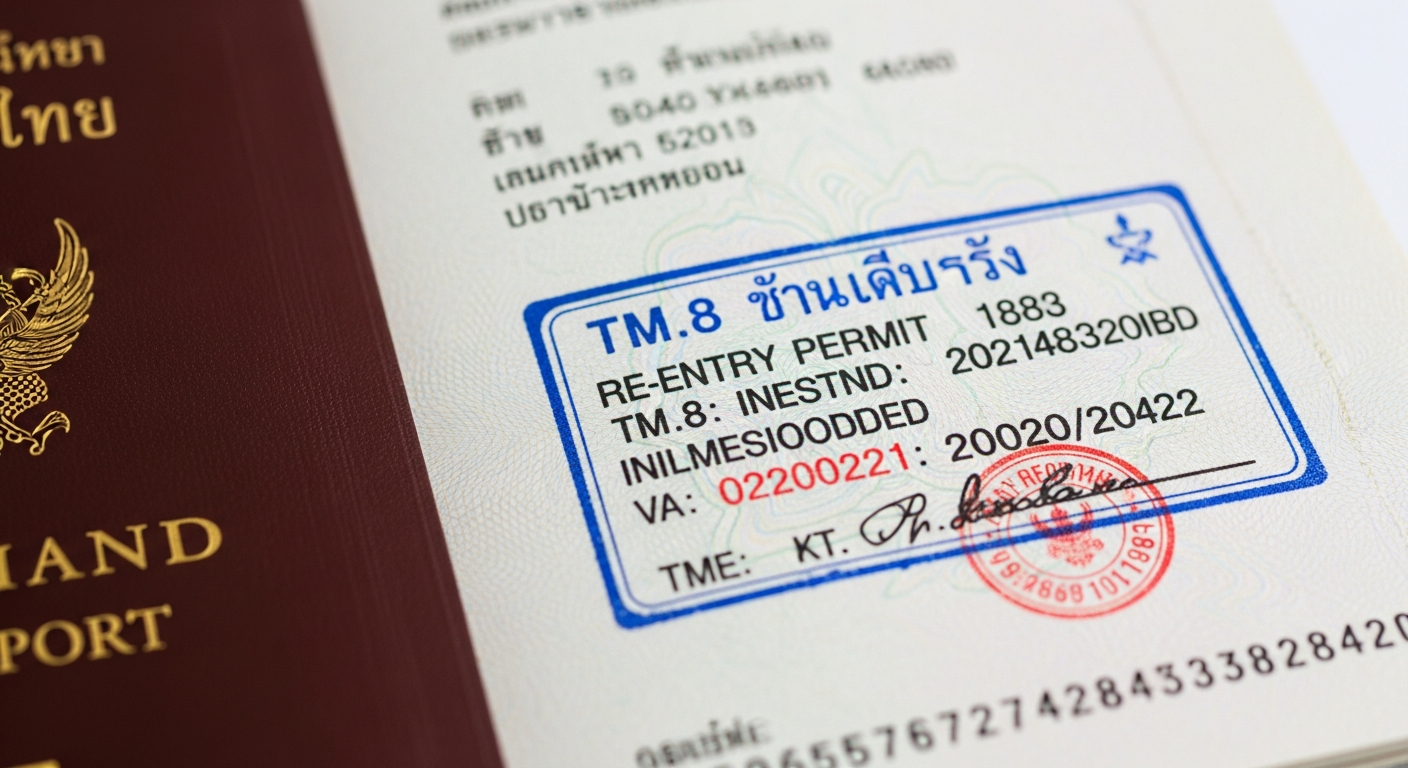
Re-entry Permits
A fundamental and incredibly strict rule of Thai immigration law is that leaving the country automatically voids your current permission to stay. If you hold a Single Entry Visa or a hard-earned 1-year Extension of Stay, crossing an international border will immediately cancel your legal right to return on that specific status. To prevent this devastating administrative reset and preserve your long-term residency, you must formally obtain a Re-entry Permit (TM.8) before you pass through outbound passport control.
What is a TM.8 Permit and Who Needs It?
A re-entry permit is exactly what its name implies: it is an official administrative stamp or physical sticker placed inside your passport that grants you the explicit permission to "re-enter" Thailand using the exact same visa status and "Admitted Until" date that you held immediately before you departed. It essentially places your current active visa into a suspended or paused state while you are abroad, ensuring that your remaining days are waiting for you when you return to the Kingdom.
You critically need to apply for a re-entry permit if you currently possess a Single-Entry Tourist Visa, an initial 90-day Non-Immigrant Visa, or if you are currently living in Thailand on an annual 1-year Extension of Stay. It is vital to understand that a 1-year extension of stay granted by a local Thai immigration office is inherently single-entry by default. The extension merely allows you to stay continuously inside the borders for a year. If you wish to travel outside those borders for a holiday or business trip, you must purchase a re-entry permit to keep the extension alive.
Single vs. Multiple Re-entry Options
When filling out the TM.8 application form, you have two distinct options. Your choice should depend entirely on your anticipated international travel frequency for the remainder of your visa's validity period:
- Single Re-entry Permit (1,000 THB): This option is valid for exactly one trip out of and back into Thailand. Once you re-enter the Kingdom and present your passport to the immigration officer, the permit is considered "used" and is immediately voided. If an emergency arises and you decide to travel again a month later, you will need to buy another Single permit. This is the most cost-effective option for expats who rarely travel.
- Multiple Re-entry Permit (3,800 THB): This powerful option allows for unlimited trips out of and back into Thailand, remaining fully active until the precise expiration date of your current visa extension. It is highly recommended for digital nomads, international executives, and frequent flyers who travel across borders several times a year, as it completely eliminates the stress of applying before every single flight.
How and Where to Apply: Step-by-Step
Securing a re-entry permit is generally one of the fastest and least bureaucratic processes in the Thai immigration system. You have three primary avenues for submitting your TM.8 form. Regardless of the method you choose, the mandatory document checklist remains identical:
- The Application Form: A fully completed and signed TM.8 form.
- Photography: One recent passport-sized photograph (4x6 cm) attached to the application.
- Passport Copies: Signed photocopies of your passport's bio-data page, the page containing your current active visa, and the page bearing your most recent entry stamp.
- Address Verification: Many local immigration offices now require proof that your TM.30 Notification of Residence is active in their system before they will issue the re-entry permit.
1. At Your Local Immigration Office
This is the safest and most highly recommended method. You can apply for your re-entry permit at the same local immigration office where you file your 90-day reports or secure your extensions. You can apply days or weeks before your scheduled flight.
Strategic Tip: Many seasoned expats smartly choose to apply for a Multiple Re-entry Permit on the exact same day they receive their new 1-year visa extension stamp. By doing the paperwork simultaneously at the immigration counter, they ensure their passport is fully ready for international travel for the entire year without needing a second visit.
2. At the International Airport (Departure Day)
If an emergency forces you to fly out unexpectedly, or if you simply didn't have time to visit a local office during business hours, you can apply for the permit directly at major international airports such as Suvarnabhumi (Bangkok), Don Mueang (Bangkok), or Phuket International Airport on the actual day of your departure.
Crucial Steps: The designated re-entry desk is located after you check in with your airline, drop your luggage, and receive your boarding pass, but before you go through the final passport control booths to exit the country. You must arrive at the airport at least 1.5 to 2 hours earlier than you normally would, as the re-entry desk can occasionally have a slow-moving queue. The airport immigration officers will typically charge an additional 200 THB "administrative convenience" or fast-track fee on top of the standard permit cost.
3. Using a Proxy or Legal Agent
If you are too busy to visit the immigration office yourself, you can authorize a proxy. By signing a formal Power of Attorney, you can grant a trusted friend, a legal representative, or a visa agency the right to submit your passport and the TM.8 paperwork to the local immigration office on your behalf. They will return your passport to you a few hours later with the re-entry stamp securely affixed inside.
🚨 The Consequences of Forgetting & Alternatives
Forgetting to secure a re-entry permit before leaving Thailand is arguably the most devastating, expensive, and time-consuming administrative error an expatriate can make. It is a mistake that cannot be undone once you pass the departure gates.
The Voided Visa Nightmare
If you hand your passport to the departure immigration officer and you do not possess a valid multiple-entry visa or a pre-purchased re-entry permit, the officer will scan your passport, stamp you out of the country, and your current visa or 1-year extension is immediately, irrevocably canceled in the national database.
When you attempt to return to Thailand a few days or weeks later, you will not be allowed back in on your old status. The border officers will force you to enter on a short-term 30 or 60-day tourist exemption stamp.
The fallout from this is massive. If you were living in Thailand on a Retirement or Marriage extension, you will have to restart the entire grueling application process from the very beginning—meaning re-depositing 400k or 800k THB into a Thai bank account, waiting the mandatory 2-month seasoning period, and submitting mountains of paperwork. If you are on a working Non-B visa, the sudden cancellation of your visa technically invalidates the foundation of your Thai Work Permit, immediately throwing your legal employment status and tax liabilities into severe chaos.
The Only Alternative: The Pre-Approved Multiple Entry Visa
The only true and legal alternative to buying TM.8 re-entry permits is to ensure you actively apply for a "Multiple Entry" visa directly from the Royal Thai Embassy in your home country before you ever travel to Thailand.
For example, if you secure a Multiple Entry Tourist Visa (METV) or a 1-year Multiple Entry Non-O Visa from your home embassy, the right to enter and exit the country unlimited times is baked directly into the original visa sticker. In this specific scenario, the TM.8 re-entry permit is entirely unnecessary. However, you must remember that if you are extending your stay locally inside Thailand via a TM.7 form, the resulting extension is always single-entry, and you are always required to buy the permit.
For official guidelines on Re-entry Permits, current airport desk locations, and to download the TM.8 form, please visit the Thai Government's official portal:
🌐 Official Thai Immigration Bureau💡 Last-Minute Airport ProTip
If relying on the airport departure desk for your re-entry permit, ensure you have exactly 1,200 THB in physical Thai Baht cash (1,000 for the permit + 200 for the desk fee) and a printed passport photo ready in your hand. Some airport desks have automated photo booths nearby, but relying on them to be functional is incredibly risky. Bring the photo and the exact cash with you to guarantee you don't miss your flight due to bureaucratic delays!
Frequently Asked Questions
Do I need a re-entry permit on a Multiple Entry Visa?
No. If your original visa obtained from a Thai Embassy is clearly marked 'Multiple Entry' and its validity date has not expired, you do not need to purchase a separate re-entry permit. You can come and go freely.
How much does a re-entry permit cost?
A Single Re-entry Permit, valid for one exit and return, costs 1,000 THB. A Multiple Re-entry Permit, which allows unlimited trips out of the country during your current visa's validity period, costs 3,800 THB.
Can I get it at the airport?
Yes, you can apply for a re-entry permit at the dedicated immigration departure desks of major international airports like Suvarnabhumi, Don Mueang, and Phuket right before you leave. There is usually a small 200 THB administrative or fast-track fee added for this convenience.
What happens if I forget to get one before I fly?
If you leave Thailand without a re-entry permit while holding a single-entry visa or a hard-earned 1-year extension of stay, your visa is immediately and permanently canceled the moment you pass through passport control. You will have to start the entire visa application process over from scratch abroad.
Explore More Immigration Services
Disclaimer: The information provided in this guide is intended for general informational and educational purposes only. Visa regulations, financial requirements, and immigration policies in Thailand are highly dynamic and subject to frequent changes by the Thai government without prior notice. REMAX Thailand is a real estate agency and does not provide formal legal or immigration advice. For the most accurate, up-to-date, and legally binding information regarding visa applications and requirements, we strongly advise consulting with a qualified immigration lawyer or visiting the official website of the Ministry of Foreign Affairs, Kingdom of Thailand (กระทรวงการต่างประเทศ).