Proof of Address 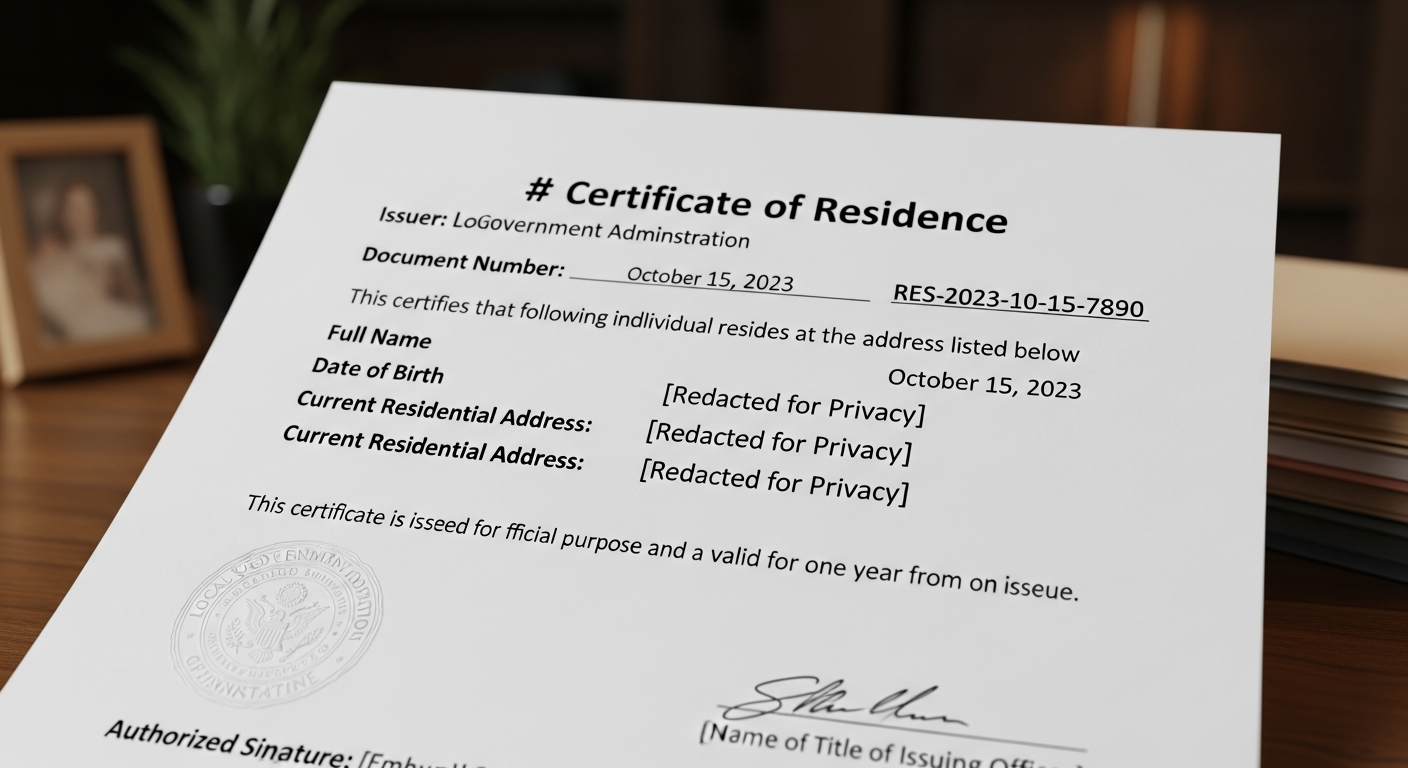
Certificates of Residence
A Certificate of Residence is a highly formalized, government-stamped document issued by the Thai Immigration Bureau that explicitly proves your current physical address in Thailand. Unlike in Western countries where a simple utility bill or bank statement is widely accepted as proof of residence, Thai bureaucratic systems mandate that foreigners produce this specific, official certificate when attempting to navigate daily life tasks, purchase significant assets, or interact with private financial institutions.
The Bureaucratic Gap: Why Do You Need This Document?
To understand why the Certificate of Residence exists, one must understand the Thai civil registration system. Thai citizens rely on a document called a "Tabien Baan" (House Registration Book) to prove their legal address. Because a foreign national's name is rarely listed in a standard blue Tabien Baan, the government requires an alternative method to officially verify where you sleep at night. The Certificate of Residence fills this massive legal gap.
You will find it virtually impossible to perform several critical lifestyle tasks without presenting one. You must obtain this official certificate if you intend to execute any of the following administrative actions in the Kingdom:
- Buying or Selling a Motor Vehicle: It is strictly required by the Department of Land Transport (DLT). If you are purchasing a car or a motorbike, you must present this certificate to transfer the vehicle ownership legally into your name. Conversely, you also need it if you are selling a vehicle to someone else so the government can deregister you.
- Acquiring a Thai Driver's License: Whether you are converting a valid international license into a Thai license or taking the written and practical tests to get a brand new one, the DLT mandates that a fresh Certificate of Residence be submitted with your application dossier.
- Opening Domestic Bank Accounts: The vast majority of major Thai banking institutions (such as Kasikorn, Bangkok Bank, or SCB) strictly require this certificate as part of their Know Your Customer (KYC) and anti-money laundering protocols before they will open a new savings account for a foreign national.
- Registering Utilities & Postpaid Services: Occasionally, telecommunications companies or utility providers may request this document when you attempt to set up a postpaid mobile phone contract or register high-speed fiber internet in your own name.
The Application Process & Requirements
To secure a Certificate of Residence, you must apply in person at the specific local immigration office that holds jurisdiction over the province where you currently live. The success of this process is entirely dependent on your address being properly and legally registered in the immigration system beforehand.
Step 1: The TM.30 Prerequisite Check
Before you even print a single photocopy, you must ensure that your landlord has successfully filed your TM.30 Notification of Residence. If the immigration officer searches your passport number in their database and cannot find an active TM.30 linked to your current address, your application for a Certificate of Residence will be rejected on the spot. If you are staying long-term, you must also be up to date on your 90-Day Reports.
Step 2: Gather Required Documentation
You must bring the following documents to the immigration desk. Ensure all photocopies are signed in blue ink:
- Application Form: A completed application form for the Certificate of Residence (provided at the desk).
- Photographs: Two recent passport-sized photos (4x6 cm).
- Passport & Copies: Your original passport, plus signed photocopies of the data page, your current visa, your latest entry stamp, and your TM.6 departure card (if you have one).
- Proof of Accommodation: A formal residential lease agreement in your name, a letter from your hotel manager, or a copy of your Thai spouse’s Tabien Baan (House Book) and ID card if you live with them.
- TM.30 Receipt: The receipt slip proving your address was registered into the system.
Step 3: Processing Times & Administrative Fees
By official decree, issuing this certificate is supposed to be a free service. However, in reality, almost every provincial immigration office charges an administrative "document preparation" or "express mailing" fee, typically ranging between 200 THB to 500 THB. Processing times vary wildly. In quiet, rural provinces, you may receive the certificate within an hour. In busy hubs like Phuket or Chiang Mai, the office may force you to wait and mail it to your address, which can take up to two weeks.
🚨 Consequences of Not Having It & Valid Alternatives
If you fail to obtain this certificate, the consequences are entirely administrative but highly restrictive: you simply will not be able to purchase a vehicle, register a vehicle legally, or secure a Thai driver's license. If you present a water bill or a residential lease to the Department of Land Transport instead of this official certificate, you will be swiftly turned away. However, there are two legal alternatives if getting the certificate from immigration proves too difficult.
Alternative 1: The Embassy Affidavit
If dealing with Thai Immigration is too cumbersome, or if you need the document immediately and cannot wait two weeks, many expats opt to visit their own country's embassy in Bangkok (such as the US, UK, or Australian embassy). Embassies offer a notary service where you swear a formal oath regarding your address, and they issue a formalized affidavit. Thai authorities (like the DLT and Banks) universally accept these embassy affidavits in lieu of the immigration certificate. However, embassies charge exorbitant fees for notary services—often between $50 and $100 USD per document—and usually require booking an appointment weeks in advance.
Alternative 2: The Thai Work Permit
If you hold a long-term extension of stay based on employment and possess a valid, physical Thai Work Permit booklet (the blue book), you generally do not need to apply for a Certificate of Residence at all. The residential address officially recorded inside your Work Permit booklet is legally recognized by the Department of Land Transport and Thai banks as definitive, government-verified proof of your residence.
For official guidelines on required paperwork and localized processing fees, please visit the Thai Government's official immigration portal:
🌐 Official Thai Immigration Bureau💡 Timing and Quantity ProTip
The Certificate of Residence is usually only valid for a strict window of 30 days from the date of its issuance. Do not apply for it until you are absolutely ready to buy that vehicle or get that license. Furthermore, the DLT requires original certificates for each separate action. If you plan to buy a car AND get a driver's license on the same day, you must request two separate original certificates from immigration simultaneously!
Frequently Asked Questions
What documents do I need to get a Certificate of Residence?
You typically need your original passport (and signed photocopies of the bio page, visa, and entry stamp), two passport-sized photos, proof of your physical address (like a formal residential lease agreement), and proof that your TM.30 notification has been filed successfully into the immigration system.
How long is the certificate valid?
The Certificate of Residence is usually only valid for 30 days from the date of its issuance. Because of this short validity window, you should apply for it right before you intend to use it at the Land Transport Office or the bank.
Is there a fee for the certificate?
Technically, under Thai immigration law, the issuance of this certificate is free of charge. However, in practice, many provincial immigration offices charge an 'expedited' processing or document preparation fee, which usually ranges from 200 to 500 THB.
Can my embassy issue one instead?
Yes, some foreign embassies in Thailand (such as the US or UK embassies) offer notary services to verify your address via an affidavit. However, embassy services are often significantly more expensive (ranging from $50 to $100+ USD) and require booking an appointment weeks in advance, making local immigration offices the preferred route.
Explore More Immigration Services
Disclaimer: The information provided in this guide is intended for general informational and educational purposes only. Visa regulations, financial requirements, and immigration policies in Thailand are highly dynamic and subject to frequent changes by the Thai government without prior notice. REMAX Thailand is a real estate agency and does not provide formal legal or immigration advice. For the most accurate, up-to-date, and legally binding information regarding visa applications and requirements, we strongly advise consulting with a qualified immigration lawyer or visiting the official website of the Ministry of Foreign Affairs, Kingdom of Thailand (กระทรวงการต่างประเทศ).